Taytay
Taytay is a Rust edge bridge for applications that capture or receive media on Linux and need to deliver it to Lunsaran reliably. It turns source output into durable, checksummed, resumable upload jobs.
This documentation is for Rust integrators and operators who need to add Taytay to a Linux edge application, implement a source adapter, or operate the reference upload process.
Taytay is intended for:
- OEMs embedding Lunsaran uploads into cameras, gateways, and field systems.
- Rust integrators building source adapters for CCTV, NVR, USB cameras, drones, LiDAR, or local file exports.
- Platform teams operating an edge worker that must survive offline periods, restarts, and transient upload failures.
It is a library and reference service boundary, not a hosted camera platform. The public crate owns edge durability and transfer orchestration. Lunsaran owns identity, organization/project authorization, and upload-session policy. Brutus owns the TUS data plane and provider execution.
Reference implementation
usb-camera-taytay repository
is Taytay's reference implementation, and its
GitHub Pages consumer guide
shows a Linux Rust CLI that publishes completed files and captured V4L2
USB-camera frames into Taytay's durable spool. Use it when you need a concrete
source application, while using this site for Taytay's reusable crate contracts
and operational boundaries.
The name
Taytay is a Hiligaynon word for “bridge”. The name reflects the crate’s role connecting edge sources and durable local state to the Lunsaran platform.
Architecture Overview
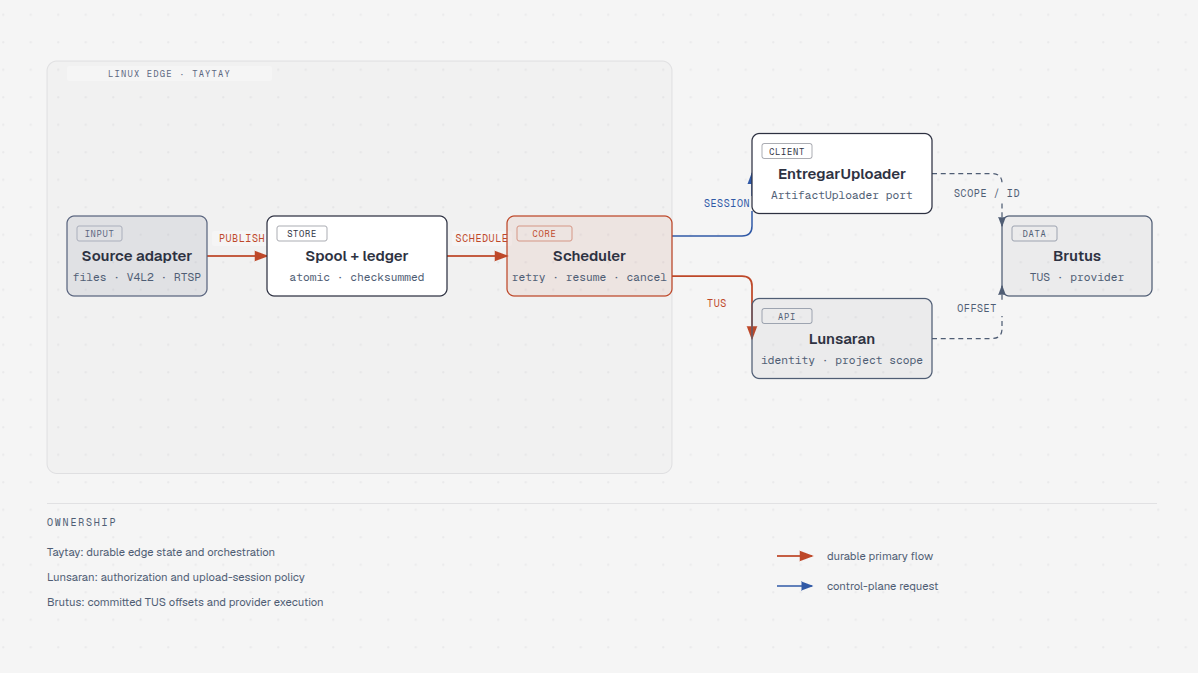
Taytay public crate architecture overview.
The diagram shows the public crate boundary: source adapters publish durable,
checksummed jobs locally; bounded Taytay workers use the ArtifactUploader
port and published Entregar client; Lunsaran authorizes the upload session;
and Brutus owns resumable TUS byte transfer and provider execution.
What the crate gives you
- Typed
Artifact,UploadJob, source, uploader, and error contracts. - Atomic publication into a quota-bounded local spool.
- SHA-256 verification before transfer and checksum-bound resume state.
- Restart recovery, bounded scheduling, retry policy, and cancellation seams.
- A public
lunsaran-entregarintegration behind Taytay’s uploader port. - Source-policy primitives for filesystem/NVR, V4L2, RTSP, ONVIF, and field metadata without coupling the core queue to a vendor SDK.
Start here
- Quick start — add the crate, publish an artifact, and run the reference diagnostics.
- Architecture — understand ownership and the execution path.
- Rust crate guide — choose the interfaces to implement.
- Durability and recovery — understand the guarantees around local files and restart behavior.
- Uploads and TUS — integrate Lunsaran sessions and resumable transfer.
- Operations — configure and run the reference service.
The private architecture and planning harness is intentionally kept outside this public documentation site. This site describes the stable consumer-facing boundary.